With love, flowers and chocolate.
Yorkshire Florist x🐰
Flowers, floral arrangements and gifts handmade in South Yorkshire. Arrangements and bouquets for all occasions.
Free Local Delivery - Visit Website
Showing posts with label eggs. Show all posts
Sunday, 1 April 2018
Monday, 17 April 2017
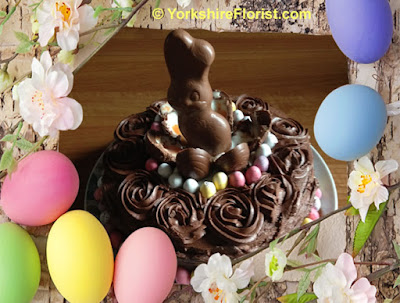
Easter Bunny Cake
Chocolate Cake with chocolate buttercream filling, decorated with chocolate mini eggs and topped with a chocolate bunny sat in a creme egg nest.
It really is a very happy Easter.
Location:
Marr, Doncaster DN5, UK
Sunday, 16 April 2017
Easter Eggs
On Easter Sunday millions of us will be tucking into delicious chocolate eggs as the Christian world celebrates.
But while many will be at least vaguely familiar with the story of Easter, its relation to eating mountains of oval-shaped chocolate treats is less clear.
So how did it come about? Easter celebrates the resurrection of Jesus after his crucifixion. Christians believe Jesus was crucified on Good Friday and rose again three days later. The three days are known as the Easter Triduum.
Even before the birth of Christianity, the egg was seen as a symbol of Spring, a celebration of the rebirth and reinvigoration after the harshness of winter.
Eggs would then be cracked against one another, leaving just empty shells - a symbol of the empty tomb Jesus left behind.
The tradition survives today in the shape of egg rolling, representing the rolling away of the rock from Jesus' tomb.
Over time, Easter eggs became more and more elaborately decorated, perhaps most famously by Russian jeweler Peter Carl Fabergé, creator of the priceless Fabergé eggs as Easter gifts for Tsars Alexander III and Nicholas II.
Over time, Easter eggs became more and more elaborately decorated, perhaps most famously by Russian jeweler Peter Carl Fabergé, creator of the priceless Fabergé eggs as Easter gifts for Tsars Alexander III and Nicholas II. The introduction of chocolate eggs is a relatively new phenomenon, originating in France and Germany in the 19th century.
Easter is currently a "movable feast" - a date determined by the lunar calendar rather than the normal Gregorian or Julian calendars, which follow the cycle of the sun.
So how did it come about? Easter celebrates the resurrection of Jesus after his crucifixion. Christians believe Jesus was crucified on Good Friday and rose again three days later. The three days are known as the Easter Triduum.
Even before the birth of Christianity, the egg was seen as a symbol of Spring, a celebration of the rebirth and reinvigoration after the harshness of winter.
Eggs would then be cracked against one another, leaving just empty shells - a symbol of the empty tomb Jesus left behind.
The tradition survives today in the shape of egg rolling, representing the rolling away of the rock from Jesus' tomb.
Over time, Easter eggs became more and more elaborately decorated, perhaps most famously by Russian jeweler Peter Carl Fabergé, creator of the priceless Fabergé eggs as Easter gifts for Tsars Alexander III and Nicholas II.
Over time, Easter eggs became more and more elaborately decorated, perhaps most famously by Russian jeweler Peter Carl Fabergé, creator of the priceless Fabergé eggs as Easter gifts for Tsars Alexander III and Nicholas II. The introduction of chocolate eggs is a relatively new phenomenon, originating in France and Germany in the 19th century.
Easter is currently a "movable feast" - a date determined by the lunar calendar rather than the normal Gregorian or Julian calendars, which follow the cycle of the sun.
Easter Bunny
Where does the Easter bunny come from?
We can blame the Germans for the Easter bunny.
Originally an 'Easter hare', a buck-toothed bringer of chocolate to the kids that have behaved themselves was first mentioned in German literature in 1682. The tradition stuck, and has led to the Easter bunnies you see on the shelves today as well as the expectation for a delivery of Easter eggs on the day.
We can blame the Germans for the Easter bunny.
Originally an 'Easter hare', a buck-toothed bringer of chocolate to the kids that have behaved themselves was first mentioned in German literature in 1682. The tradition stuck, and has led to the Easter bunnies you see on the shelves today as well as the expectation for a delivery of Easter eggs on the day.
Location:
Goldthorpe, UK
Easter Facts
The first chocolate egg in the UK was produced in 1873 by Fry’s of Bristol
On Easter Sunday, some people traditionally roll painted eggs down steep hills
The gesture of giving eggs at Easter has been traced back to Egyptians, Persians, Gauls, Greeks and Romans. Back then the egg was a symbol of life
Every child in the UK receives an average of 8.8 Easter eggs every year – double their recommended calorie intake for a whole week
When tucking into a chocolate bunny rabbit, 76 per cent of people bite the ears off first
On Easter Sunday, some people traditionally roll painted eggs down steep hills
The gesture of giving eggs at Easter has been traced back to Egyptians, Persians, Gauls, Greeks and Romans. Back then the egg was a symbol of life
Every child in the UK receives an average of 8.8 Easter eggs every year – double their recommended calorie intake for a whole week
When tucking into a chocolate bunny rabbit, 76 per cent of people bite the ears off first
Location:
Mexborough, UK
Subscribe to:
Posts (Atom)